A small backyard does not mean a small pool experience. Some of the most striking pools we have built in the Coachella Valley sit in compact spaces — and in many cases, the size constraint pushed the design toward something more interesting than what a larger lot would have produced.
The challenge is real, though. A pool that feels spacious and functional in a generous backyard can feel cramped and awkward in a smaller one. The difference is almost never about the pool itself — it is about how the pool, the hardscape, the shade, and the surrounding elements are designed to work together as a single space.
Here is what actually works in a small desert backyard, and why.
Start With How You Actually Use the Space
Before dimensions, before shapes, before features — the most important question is how you plan to use the pool and the yard around it.
A couple who entertains regularly has completely different priorities than a family with young children, or someone who wants a private retreat after work. A small backyard that is designed around how you actually live in it will feel larger and more functional than one designed around how it looks in a photo.
When we sit down with clients who have a compact lot, this is always the first conversation. The design follows the lifestyle, not the other way around.
Design Approaches That Work in Small Desert Backyards
The Plunge Pool: Maximum Impact, Minimum Footprint
If your priority is cooling off in the desert heat rather than lap swimming or large gatherings, a plunge pool is worth serious consideration. Typically ranging from 8 to 15 feet in length, a plunge pool is designed for exactly what the name suggests — getting in, cooling down, and getting out.
In the Coachella Valley, where the primary function of a pool for many owners is relief from 110°F heat rather than recreation, a plunge pool delivers that function with a fraction of the space and construction cost of a full-size pool.
A well-designed plunge pool with the right surrounding hardscape and landscaping can become the visual and functional centerpiece of a small backyard — often more dramatically than a larger pool would in the same space.
The Lap Pool: Long, Narrow, and Surprisingly Versatile
A long, narrow pool — typically 8 to 10 feet wide and 30 to 40 feet long — fits naturally against a property line or fence and leaves usable outdoor space on at least one side. Originally designed for swimming exercise, the lap pool format has evolved into one of the most popular small-backyard solutions because of how efficiently it uses linear footage.
In terms of desert function, a lap pool’s narrower width actually works in your favor for shade planning — a pergola, shade sail, or covered patio on one side can protect more of the pool surface from direct sun, reducing water temperature and evaporation.
For small backyards with a longer dimension than a wider one — a common lot configuration in many Coachella Valley communities — a lap pool is often the most natural fit.
The Geometric Pool With Integrated Hardscape
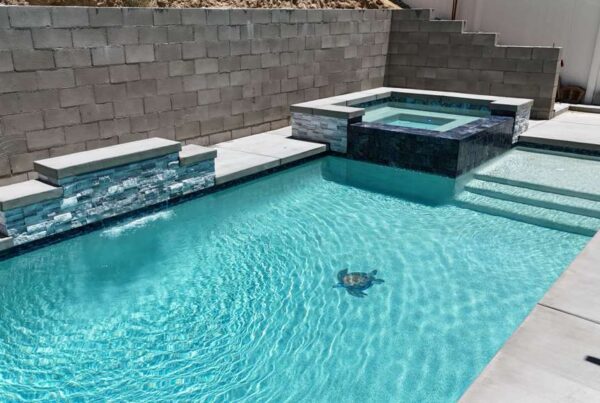
In a small space, the line between the pool and the surrounding hardscape should blur, not contrast. A geometric pool — rectangular, L-shaped, or square — designed as part of a unified hardscape plan creates the illusion of a larger, more intentional space.
The key is treating the deck, the pool edge, and any surrounding structure as one continuous design rather than a pool surrounded by separate patio. Using the same material — travertine, concrete, or large-format pavers — from the pool coping through the surrounding deck visually expands the space.
In the desert, light-colored hardscape materials also serve a functional purpose: they reflect rather than absorb heat, keeping the area around the pool more comfortable during peak afternoon hours.
The Elevated Spa With Spillover
When the backyard is too small for both a full pool and a separate spa, a raised spa with a spillover waterfall into a smaller pool solves both problems in a compact footprint. The elevated spa becomes a visual focal point and a functional feature — and the sound of moving water adds to the atmosphere in a way that a static pool cannot.
This configuration works especially well in backyards where there is a natural slope or level change — the elevation difference that would otherwise be a landscaping challenge becomes a design asset.
The Courtyard Pool
Some small backyards are not just small — they are enclosed, surrounded on multiple sides by the house, walls, or structures. The courtyard format leans into that enclosure rather than fighting it, designing the pool as the center of a private outdoor room.
In desert climates, a courtyard’s enclosed walls actually offer shade advantages — east and west walls block low-angle morning and afternoon sun, reducing the heat load on the pool and the surrounding space. A courtyard pool in Palm Desert or La Quinta can be comfortable and usable well into the afternoon during summer, when an open south-facing backyard is not.
Features That Add Value Without Adding Footprint
Small backyards reward thoughtful feature selection. The goal is to choose elements that add function or ambiance without consuming space that could be used for something else.
Tanning ledge (Baja shelf): A shallow, submerged ledge — typically 6 to 12 inches deep — built into one end of the pool. It functions as a lounge area in the water, a safe entry point for children, and a place to set drinks or a sun chair partially submerged. In a small pool it replaces what would otherwise be wasted shallow-end space and turns it into the most-used part of the pool.
In-pool seating and bench areas: Built-in underwater benches along one or two walls add lounge space without requiring additional pool square footage. They are especially effective in plunge pools and smaller geometric designs where the pool doubles as a social gathering space.
Deck jets and bubblers: Water features do not require a dedicated waterfall structure or significant space. Deck jets — thin arcs of water that shoot from the pool deck into the water — and bubblers that rise from the tanning ledge add visual movement and the sound of water in a minimal footprint. They are also easier to shade and heat-manage than raised water features.
Vertical landscaping: In a small backyard, plants that grow up rather than out — tall ornamental grasses, columnar cacti, climbing vines on a trellis — create a sense of enclosure and privacy without consuming horizontal space. Native desert plants along the pool perimeter also reduce water use and maintenance compared to traditional landscaping.
Strategic lighting: Well-placed underwater LED lighting and perimeter landscape lighting extend usable hours dramatically in the desert, where evenings from April through October are often the most comfortable time to be outside. A pool that looks inviting at 8 PM on a July evening gets more use than one that goes dark after sunset.
What to Avoid in Small Desert Backyards
A few common mistakes that we see in small backyard pool projects:
Oversizing the pool relative to the lot. It is tempting to maximize pool size, but a pool that takes up 80% of a small backyard leaves no room to actually enjoy being outside. A pool surrounded by a narrow strip of concrete on all sides feels claustrophobic, not luxurious. The best small-backyard pools leave enough surrounding space to feel generous.
Ignoring sun orientation. In a large backyard you have room to position the pool however you like. In a small one, sun orientation matters significantly — both for comfort and for managing water temperature during summer. A pool that bakes in direct western sun all afternoon is harder to use and more expensive to maintain. We evaluate sun angles and shade opportunities as part of the design process.
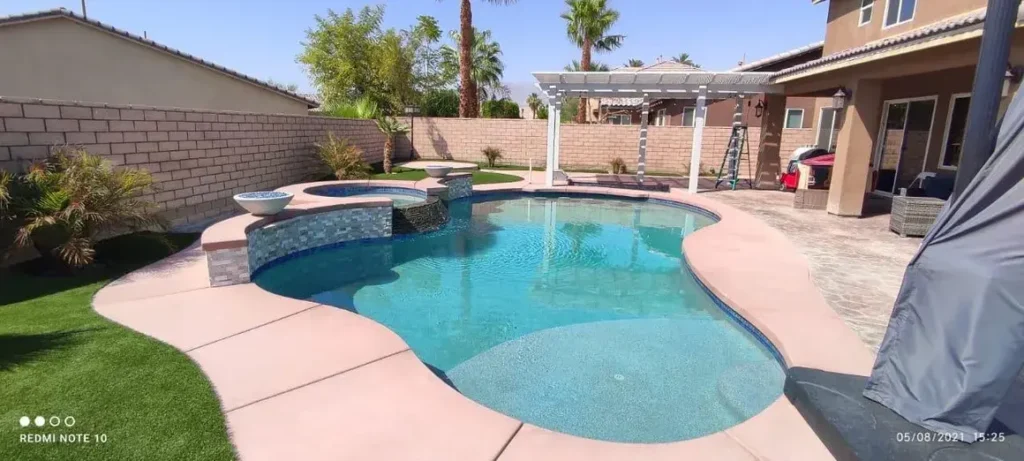
Choosing a shape that fights the space. A freeform organic shape can look beautiful in a large backyard with room to breathe around it. In a tight space, that same shape often feels awkward and wastes the linear footage that a geometric design would use efficiently. Matching the pool shape to the geometry of the space is one of the most impactful small-backyard design decisions.
Underestimating equipment placement. Every pool needs a pump, filter, and potentially a heater — and those components need accessible space. In a small backyard, where equipment ends up matters. Planning for it from the beginning allows it to be placed efficiently and, if desired, concealed behind a low wall or screen without creating a maintenance access problem.
How the Desert Changes Small-Backyard Design
A few factors specific to the Coachella Valley that influence design decisions in compact spaces:
Shade is a design element, not an accessory. In a climate where pool decks can reach 140°F on a July afternoon, a pergola, shade sail, or extended covered patio is not optional for a pool space that gets real use. In a small backyard, designing shade into the original plan — rather than adding it later — is significantly more effective and usually less expensive.
Light-colored surfaces everywhere. Dark pavers, dark concrete, and dark pool finishes absorb and retain heat. In a small backyard where there is less overall surface area to work with, the color and material choices matter more. Light travertine, white concrete, or pale aggregate finishes reflect more heat and keep the space cooler and more comfortable.
Water-efficient landscaping fills space without adding maintenance. Native desert plants, decomposed granite, and low-water ground covers fill the non-pool areas of a small backyard with texture and visual interest without competing with the pool for attention or creating a significant maintenance burden.
Getting the Most From a Consultation
If you are working with a small backyard, the most valuable thing you can do before committing to a design is walk through the space with someone who has designed pools in similar lots before.
Dimensions on paper do not always reveal what will and will not work in a specific space. Sun angle, existing structures, soil conditions, utility locations, and the way the backyard connects to the interior of the house all affect what is possible and what will perform best.
We offer free on-site design consultations across the Coachella Valley — Palm Desert, Indio, La Quinta, Palm Springs, Cathedral City, Rancho Mirage, and surrounding desert communities. We have built pools in some of the most compact lots in the area and know what the space can do.
Schedule your free consultation: Contact JB Pools
Quick Reference: Pool Formats for Small Desert Backyards
| Format | Best For | Typical Size | Desert Advantage |
|---|---|---|---|
| Plunge pool | Cooling off, minimal budget, tight lots | 8–15 ft long | Low evaporation, easy to shade |
| Lap pool | Exercise, long narrow lots | 8–10 ft wide / 30–40 ft long | One-side shade coverage |
| Geometric with hardscape | Entertaining, visual impact | Flexible | Unified design maximizes perceived space |
| Elevated spa + spillover | Spa priority, level changes | Compact | Feature-forward with small footprint |
| Courtyard pool | Enclosed spaces, privacy | Flexible | Natural shade from surrounding walls |
JB Pools Inc. has been building custom pools in the Coachella Valley since 2004. Family-owned and operated from Palm Desert, CA. We design and build pools for lots of every size across Indio, La Quinta, Palm Springs, Cathedral City, Rancho Mirage, and surrounding desert communities. (760) 393-1326